28.10.2026

Bridges change length with the seasons. Dr.-Ing David Sanio explains how civil engineers make sure they remain safe to drive on all year round.
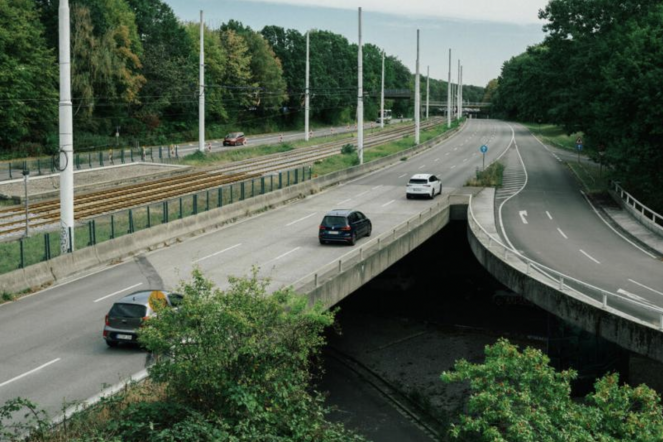
Drivers crossing a bridge usually think of it as a fixed, immovable structure. In reality, it constantly adapts to the temperature: it gets longer in summer and shorter in winter. The cause is the thermal expansion of solid materials. Dr.-Ing David Sanio from the Chair of Massive Construction explains how bridge engineering deals with this.
Why materials expand
As temperature rises, the atoms of a material move more vigorously, the distance between them grows, and the material expands. Steel lengthens by 0.012 millimeters per meter for every degree Celsius. Concrete behaves almost identically. This is a stroke of luck, because it means no internal stresses build up between the steel and the concrete in reinforced concrete.
What planners factor in
In Germany, engineers calculate with a temperature range of about 60 degrees Celsius between summer and winter, plus safety margins. They also take into account that steel bridges heat up more in the sun than massive concrete bridges. A 100-meter bridge therefore changes its length by 72 millimeters, while the 1.8-kilometer Ruhrtalbrücke between Mülheim an der Ruhr and Essen changes by more than a meter.
Two solutions
First, bearings between the superstructure and the piers carry the bridge while letting it slide freely in the longitudinal direction. Only a single fixed bearing holds it in place at one point. Second, expansion joints (known in German as ÜKOs) at the bridge ends absorb the movement. For large deformations, Lamellar transitions are used, which spread the movement across many small steps, much like an accordion. Each lamella absorbs about 100 millimeters; with 13 lamellas at each end of the Ruhrtalbrücke, that adds up to roughly 2.6 meters.
You can find more about this topic in the article "Schrumpfen Brücken im Winter?" in the "Wissenshäppchen" series in the RUB-Newsportal.
Copyright © fbi 2026
Last update: Oct 28, 2026