29.06.2026
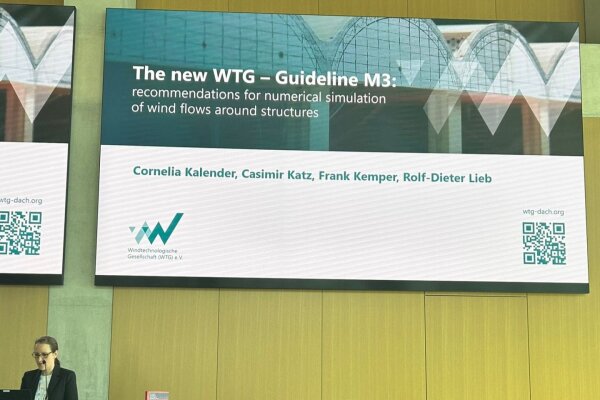
The Wind Technology Society e.V. presented its new Technical Bulletin, “Numerical Simulation of Wind Flows,” at the 8th International Symposium on Computational Wind Engineering in Canada.
The English version was presented to an international audience of experts by Dr. Cornelia Kalender, who played a key role in the development of the technical bulletin over several years.
As a conference of the International Association for Wind Engineering (IAWE), CWE 2026 focused on the question of what role computational fluid dynamics (CFD) methods will play in the future in determining wind loads in the building industry. The contribution to the WTG Technical Note M3 fit perfectly into the international discussion, which was shaped, among other things, by research and reports from Japan, the U.S., and other countries.
A central topic of the conference was the use of large-eddy simulations (LES) to determine wind loads. When properly applied by experienced specialists, these methods are now widely regarded as established.
As a result, additional benchmark studies alone are becoming less and less of a priority. Rather, a thorough understanding of the remaining uncertainties and sources of error remains crucial. Only on this basis can the potential of numerical flow simulations be reliably harnessed and their limitations appropriately taken into account.
With the presentation of the WTG Technical Note M3, the German-speaking professional community was able to demonstrate its high level of activity and commitment on an international level. At the same time, the discussion at the conference revealed a gratifyingly broad consensus regarding the fundamental approaches to applying CFD methods for determining wind loads. The WTG’s contribution thus provided an important impetus for international technical exchange and the further harmonization of evaluation and application standards in the field of wind engineering.
The Wind Technology Society e.V. presented its new Technical Bulletin, “Numerical Simulation of Wind Flows,” at the 8th International Symposium on Computational Wind Engineering in Canada.
The English version was presented to an international audience of experts by Dr. Cornelia Kalender, who played a key role in the development of the technical bulletin over several years.
As a conference of the International Association for Wind Engineering (IAWE), CWE 2026 focused on the question of what role computational fluid dynamics (CFD) methods will play in the future in determining wind loads in the building industry. The contribution to the WTG Technical Note M3 fit perfectly into the international discussion, which was shaped, among other things, by research and reports from Japan, the U.S., and other countries.
A central topic of the conference was the use of large-eddy simulations (LES) to determine wind loads. When properly applied by experienced specialists, these methods are now widely regarded as established.
As a result, additional benchmark studies alone are becoming less and less of a priority. Rather, a thorough understanding of the remaining uncertainties and sources of error remains crucial. Only on this basis can the potential of numerical flow simulations be reliably harnessed and their limitations appropriately taken into account.
With the presentation of the WTG Technical Note M3, the German-speaking professional community was able to demonstrate its high level of activity and commitment on an international level. At the same time, the discussion at the conference revealed a gratifyingly broad consensus regarding the fundamental approaches to applying CFD methods for determining wind loads. The WTG’s contribution thus provided an important impetus for international technical exchange and the further harmonization of evaluation and application standards in the field of wind engineering.
Copyright © fbi 2026
Last update: Jun 29, 2026