08.07.2026
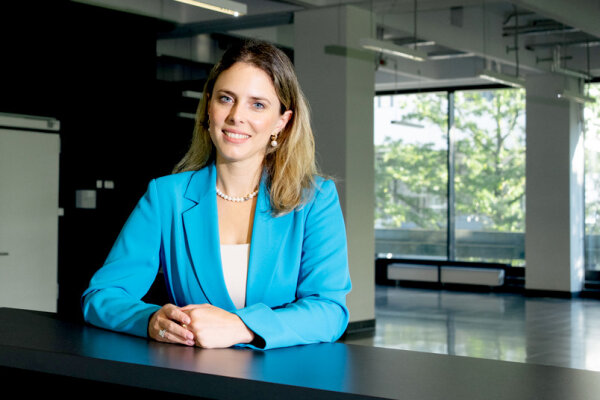
Prof. Dr.-Ing. Merita Tafili has held the Chair of Computational Geotechnics in the Faculty of Civil and Environmental Engineering since April 2026. Learn more about her research and future projects.
Prof. Dr.-Ing. Merita Tafili combines numerical simulation, modern material models, and artificial intelligence to predict how soils behave under complex loads. This is relevant, for example, for dikes or offshore wind turbines, which must withstand cyclic wind and wave loads over decades.
Her approach goes well beyond classical geotechnical engineering. With her Emmy Noether Junior Research Group, she is investigating how foundations can simultaneously be used as energy storage systems, such as for geothermal energy. In Collaborative Research Center 1683, “Interaction Methods for the Modular Reuse of Existing Structural Systems”, she is also developing solutions to reuse existing foundations instead of building new ones, thereby saving resources, reducing CO₂ emissions, and cutting costs. In the long term, she aims to establish soil as a multifunctional material that supports structures, stores energy, and adapts.
A key priority for Tafili remains the promotion of early-career researchers, to whom she has dedicated a separate graduate college within SFB 1683.
Prof. Dr.-Ing. Merita Tafili has held the Chair of Computational Geotechnics in the Faculty of Civil and Environmental Engineering since April 2026. Learn more about her research and future projects.
Prof. Dr.-Ing. Merita Tafili combines numerical simulation, modern material models, and artificial intelligence to predict how soils behave under complex loads. This is relevant, for example, for dikes or offshore wind turbines, which must withstand cyclic wind and wave loads over decades.
Her approach goes well beyond classical geotechnical engineering. With her Emmy Noether Junior Research Group, she is investigating how foundations can simultaneously be used as energy storage systems, such as for geothermal energy. In Collaborative Research Center 1683, “Interaction Methods for the Modular Reuse of Existing Structural Systems”, she is also developing solutions to reuse existing foundations instead of building new ones, thereby saving resources, reducing CO₂ emissions, and cutting costs. In the long term, she aims to establish soil as a multifunctional material that supports structures, stores energy, and adapts.
A key priority for Tafili remains the promotion of early-career researchers, to whom she has dedicated a separate graduate college within SFB 1683.
A more detailed profile of Prof. Dr.-Ing. Merita Tafili can be found here on the RUB News Portal.
Copyright © fbi 2026
Last update: Jul 08, 2026